
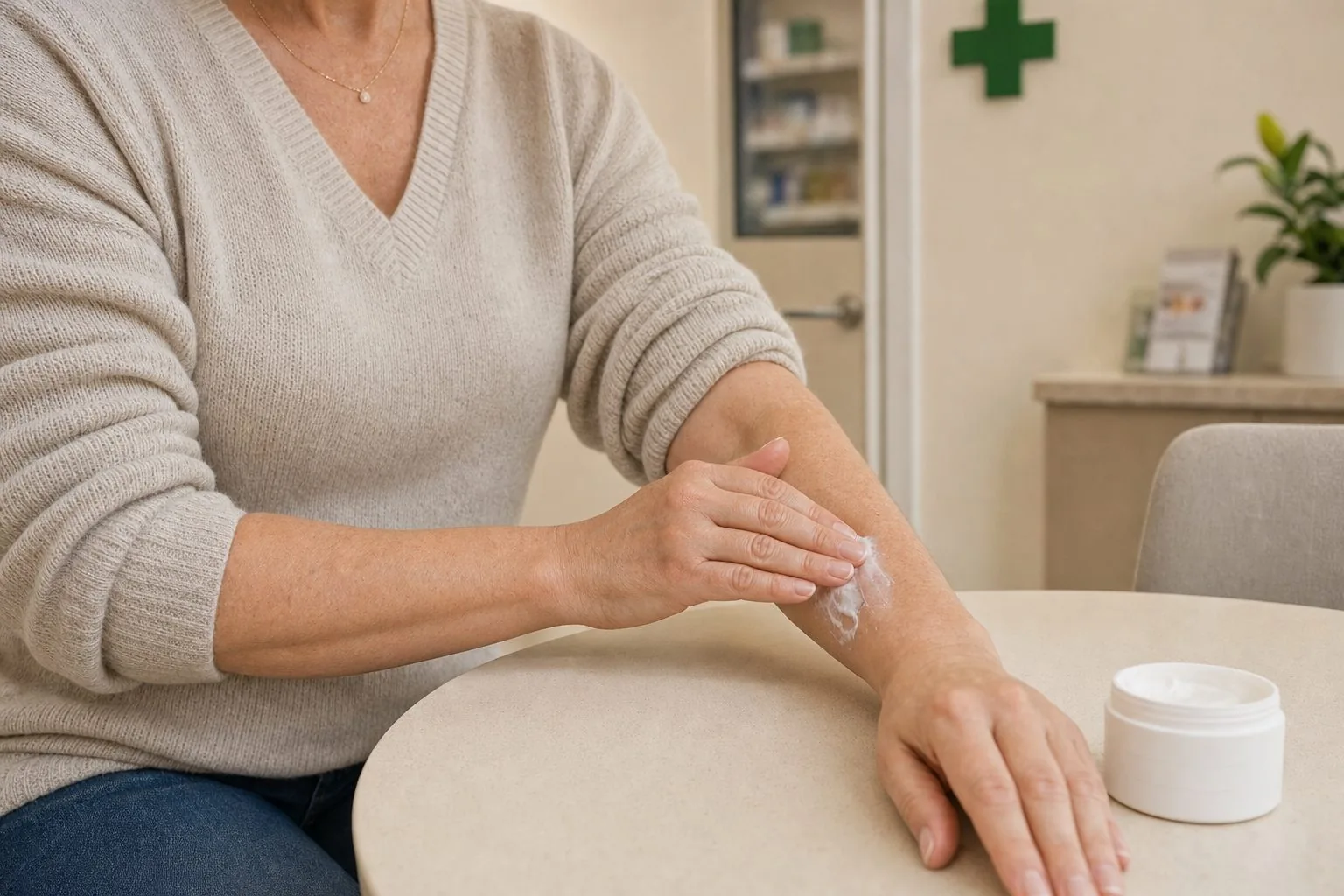
 Image is illustrative and does not show Hyde Park Pharmacy premises or staff.
If you live with eczema or very dry skin, an emollient isn't an optional extra. It's the treatment you use every day, whether or not your skin is flaring. Yet most of the questions we get at the counter come down to the same thing: there are dozens of tubs, tubes and pumps on the shelf, and it's hard to know which one to pick or how to use it properly.
This guide explains what emollients are, how the different types compare, how much to use and how to put it on. It also covers some of the products people ask us about most: Diprobase, Aveeno Dermexa, E45 Eczema Repair, Epimax, Eumovate and Cocois. You can also browse everything we stock for the condition on our Eczema & Dermatitis page.
What is eczema, and why does dry skin matter?
Atopic eczema, the most common type, is a long-term condition that makes skin dry, itchy and cracked. It tends to come and go, with calmer spells between flare-ups, and it often runs in families alongside asthma and hay fever (NHS: atopic eczema).
Healthy skin works as a barrier: it holds water in and keeps irritants out. In eczema that barrier is leaky. Water escapes, the skin dries and cracks, and soaps, detergents and allergens get in more easily. That causes itching, the scratching damages the skin further, and the cycle carries on. Breaking this cycle is the main reason emollients are used every day and not only when a flare starts.
What an emollient actually does
Emollients are moisturising treatments put directly on the skin. They come as lotions, sprays, creams and ointments, and many leave-on emollients can also be used to wash with instead of soap. They work by covering the skin with a protective film that slows down water loss, softens the skin and makes it less itchy (NHS: emollients).
NICE guidance treats emollients as the foundation of eczema care. They should be used all the time, including when the skin looks clear, and you should keep using them during a flare even if another treatment is added (NICE CKS: atopic eczema). They don't cure eczema, but used properly they can mean fewer flare-ups and less need for steroid creams.
Who this guide is for
This guide is for:
- adults with mild to moderate atopic eczema or generally dry, rough skin
- parents and carers looking after a child with eczema
- anyone whose emollient doesn't seem to be working, or who isn't sure they're using it correctly
- people who have been told to "use an emollient" and don't know where to start.
It doesn't replace seeing a GP: the NHS advises seeing a GP if you or your child have symptoms of eczema, or if treatments are not helping, and we're always happy to tell you who to see. Eczema that looks infected (hot, swollen or painful, or with a high temperature or feeling unwell) needs an urgent GP appointment or NHS 111 (NHS: atopic eczema).
Lotion, cream or ointment: what's the difference?
The main difference between emollient types is how much oil they contain compared with water. More oil means a greasier feel and longer-lasting protection. More water means the product is lighter and sinks in faster (NHS: emollients). No single type is right for everyone. The one that works is the one you'll actually use, so many people end up with two. The NHS suggests you may want to use a cream during the day and an ointment at night.
Choosing an eczema emollient cream
The emollients most people think of are creams, because they're easy to spread and less greasy than ointments. When choosing one, check for these:
- No fragrance. Perfumes are a common irritant for skin that's already inflamed. NICE recommends unperfumed emollients for eczema (NICE CG57).
- Hygienic packaging. Pump dispensers are less likely to get contaminated than tubs (NICE CKS: emollients). If you do use a tub, take the product out with a clean spoon or spatula, not your fingers (NHS: emollients).
- Ingredients you tolerate. Skin reactions are usually caused by additives such as perfumes, preservatives or lanolin. If a reaction happens, stop that emollient and use a different one (NICE CKS: emollients).
- A big enough pack. You'll go through more than you'd expect (see the quantities below), so a large pump is usually more practical than a small tube.
Diprobase Advanced Eczema Cream
The Diprobase Advanced Eczema Cream 500ml pump is an emollient cream for eczema-prone skin, in a pump dispenser. The older Diprobase ointment has been discontinued, so if you'd like something greasier for very dry patches or for night-time, ask us about a plain paraffin-based ointment. The leaflet in the pack explains how to apply the cream.
Aveeno Dermexa Daily Emollient Cream
Aveeno Dermexa Daily Emollient Cream is a cream for very dry, itchy, eczema-prone skin. It contains colloidal oatmeal and spreads easily, so it's often chosen for all-over daily use.
E45 Eczema Repair Cream
E45 Eczema Repair Cream is a cream for eczema-prone skin. It isn't a licensed medicine, so use it as the directions on the pack say.
Epimax Original
Epimax Original Cream is a simple paraffin-based cream (white soft paraffin and liquid paraffin). Its maker directs it to be used as a leave-on moisturiser or as a body wash in the bath or shower, and to avoid contact with the eyes.
| Product | Type | Texture | Often used for |
|---|---|---|---|
| Diprobase Advanced Eczema Cream | Cream | Light, soaks in | Daytime use |
| Aveeno Dermexa Daily Emollient Cream | Cream (with colloidal oatmeal) | Light to medium | All-over daily use |
| E45 Eczema Repair Cream | Cream | Light to medium | Eczema-prone patches |
| Epimax Original Cream | Paraffin-based cream | Medium | Leave-on moisturiser and body wash |
This table describes texture and typical use only. It doesn't rank how well the products work. NICE recommends that people try a few emollients and pick the one they'll keep using (NICE CG57).
How much to use, and how to apply it
Emollients need to be used liberally and often, even when the skin looks clear. NICE recommends that 250 to 500 g of emollient is applied every week (NICE CKS: emollients).
The NHS gives this advice on putting it on (NHS: emollients):
- Use plenty, and smooth it on gently in the direction the hair grows. Don't rub it in hard.
- Put it on often, ideally at least 3 or 4 times a day, and as soon as you've patted your skin dry after washing.
- After a bath or shower, pat your skin dry gently instead of rubbing.
- Use an emollient wash in place of ordinary soap and bubble bath, which dry the skin out.
- Keep going when your skin looks clear. Emollients help prevent flare-ups.
If you've also been given a steroid cream, the NHS advises waiting 20 to 30 minutes between using your emollient and using the steroid, so the emollient doesn't dilute it or spread it onto skin that doesn't need it. Ask a doctor which one to use first (NHS: emollients).
When an emollient isn't enough: steroid creams such as Eumovate
During a flare, the skin is inflamed as well as dry, and emollients alone may not settle it. That's when a topical corticosteroid (steroid cream) is usually added for a short course. You keep using the emollient alongside it (NICE CKS: atopic eczema). Steroid creams come in different strengths, and the strength suited to you depends on how bad the flare is, where it is on the body, and your age.
Eumovate cream from the pharmacy
Eumovate Eczema & Dermatitis Cream contains a moderate-strength steroid (clobetasone butyrate). This small pack is a pharmacy medicine, which means a pharmacist has to agree it's suitable before it can be supplied. It's for short-term treatment of eczema and dermatitis flare-ups in the age groups the patient leaflet lists, and it shouldn't be used for longer than the leaflet says without getting advice. Always read the label and patient information leaflet before use. When you ask for it, our pharmacist will ask about your skin, where the eczema is and what you've tried already. They'll then decide whether it's appropriate or whether you'd be better seeing your GP.
Eumovate ointment
Eumovate also comes as an ointment, which has a greasier base. The ointment is prescription-only, so it can't be bought over the counter. Your GP can advise whether a prescription treatment is right for you.
Can you use Eumovate on your face?
Not the version you buy from a pharmacy: its patient leaflet says not to use it on the face. The NHS advises not to use clobetasone (the steroid in Eumovate) on your face without talking to a pharmacist or doctor first, because it can damage the skin there (NHS: clobetasone). If you have eczema on your face, ask us or your GP what to use.
Cocois and eczema on the scalp
Cocois is a medicated ointment made with coconut oil, for dry, scaly skin conditions of the scalp such as psoriasis, eczema and dandruff (Cocois patient leaflet). It isn't an everyday moisturiser. It's applied to the scalp, left on for a while and then washed out, as the patient leaflet describes. It contains coal tar and can stain clothes and jewellery. Don't use it on broken or infected skin, while breastfeeding, or in the last 3 months of pregnancy; in the first 6 months of pregnancy its leaflet says to use it only if a doctor advises it is clearly necessary. It isn't for children under 6, and children aged 6 to 12 should only use it under medical supervision (Cocois patient leaflet).
Risks and what to watch for
Emollients are very safe, but there are a few things to know:
- Slippery surfaces. Emollient washes and ointments make baths, showers and floors slippery. Take care, especially with children and older adults.
- Stinging or burning. If an emollient causes stinging or a burning feeling that doesn't settle after a few days, it's usually a reaction to an ingredient. Talk to a pharmacist, GP or nurse (NHS: emollients).
- Folliculitis. Emollients can block or inflame hair follicles. Smoothing them on in the direction your hair grows, not rubbing them in, helps prevent this (NHS: emollients).
- Signs of infection. If eczema becomes weeping, crusted, quickly worse or painful, or you have a fever or feel unwell, see a GP or call NHS 111 promptly. Painful, clustered blisters need urgent attention (NHS: atopic eczema).
If you think a medicine or a medical device (many emollients are medical devices) has caused a side effect, you can report it to the MHRA through the Yellow Card scheme.
What to be wary of online
Be cautious with "eczema creams" bought from overseas sellers or social media, particularly ones that promise very quick results or describe themselves as "natural" or "herbal". The MHRA has found unlicensed skin products that contained undeclared strong steroids, which can thin the skin and cause problems when you stop using them. Steroid creams that need a prescription in the UK shouldn't be sold without one. If a site doesn't show a UK registered pharmacy with a GPhC number you can check, don't buy from it. You can report suspect products to the MHRA through the Yellow Card scheme.
How a consultation works at Hyde Park Pharmacy
You don't need an appointment to talk about eczema or dry skin. You can come in, phone or send us a WhatsApp message. Here's what to expect:
- We ask about your skin. Where the eczema is, how long it's been there, how it's affecting sleep and daily life, and what you've already tried.
- We look at your routine. How much emollient you use, how often, and whether you've swapped soap for an emollient wash.
- The pharmacist reviews and decides. If a pharmacy medicine such as a steroid cream might help, the pharmacist will review your answers and decide whether it's appropriate. If it isn't, they'll explain why.
- We refer you when needed. If treatments are not helping, we'll tell you to see a GP, and if the skin looks infected, to get an urgent GP appointment or call NHS 111 (NHS: atopic eczema).
Frequently asked questions
Is an ointment or a cream better for eczema?
Neither is better overall. Ointments are greasier and last longer, so they suit very dry skin and night-time. Creams are lighter and easier to use during the day, and many people use both. The NHS suggests trying a few emollients to find the one that suits your skin (NHS: emollients).
What is the difference between an emollient and a normal moisturiser?
Emollients for eczema are a treatment: they're used generously, ideally at least 3 or 4 times a day, to keep the skin's protective barrier working (NHS: emollients). NICE recommends unperfumed emollients for eczema, because perfumes are a common cause of skin reactions (NICE CKS: emollients).
Can I use E45 Eczema Repair Cream every day?
Follow the directions on the pack, and stop if it irritates your skin. For eczema, NICE advises using emollients liberally and often, even when the skin looks clear (NICE CKS: emollients).
Can I put Eumovate on my face?
The pharmacy pack isn't for use on the face: its leaflet says so. The NHS advises not to use clobetasone on your face without talking to a pharmacist or doctor first (NHS: clobetasone).
Can I buy Eumovate ointment from a pharmacy?
No. The ointment is prescription-only. The cream in a small pack is a pharmacy medicine, and the pharmacist will ask a few questions before deciding whether it's suitable for you.
Is Cocois a moisturiser?
No. Cocois is a medicated scalp ointment for scaly scalp conditions. It's applied, left on for a while and then washed out, as the patient leaflet describes. For everyday dryness elsewhere on the body, use an emollient.
What if my eczema isn't getting better?
See a GP if treatments are not helping your eczema, and ask for an urgent GP appointment or call NHS 111 if the skin looks infected (NHS: atopic eczema). You may need a different product or an added treatment (NICE CKS: atopic eczema).
Not sure which emollient to try?
Message or call our pharmacist team for general advice about your skin, including when it's better to see your GP. Any treatment is supplied only after a pharmacist has checked it is suitable for you.
WhatsApp a pharmacist Call 0113 244 1551Regulatory information
Hyde Park Pharmacy is operated by Pharmacareuk Ltd, 22-24 Woodsley Road, Leeds LS3 1DT. Registered pharmacy premises with the General Pharmaceutical Council, registration number 9011727. You can check our registration on the GPhC register.
Superintendent pharmacist: Shoyab Umarji (GPhC 2065619).
Report suspected side effects from medicines or medical devices to the MHRA through the Yellow Card scheme.
Sources
Where to get treatment
Our pharmacist can check what suits you. Every treatment is supplied only after a pharmacy consultation confirms it is appropriate.
Diprobase Advanced Eczema Cream 500ml Pump →Eumovate Eczema & Dermatitis Cream →Aveeno Dermexa Daily Emollient Cream →Eczema & Dermatitis treatments →This is general information. Always consult a qualified healthcare professional before starting any new treatment.