
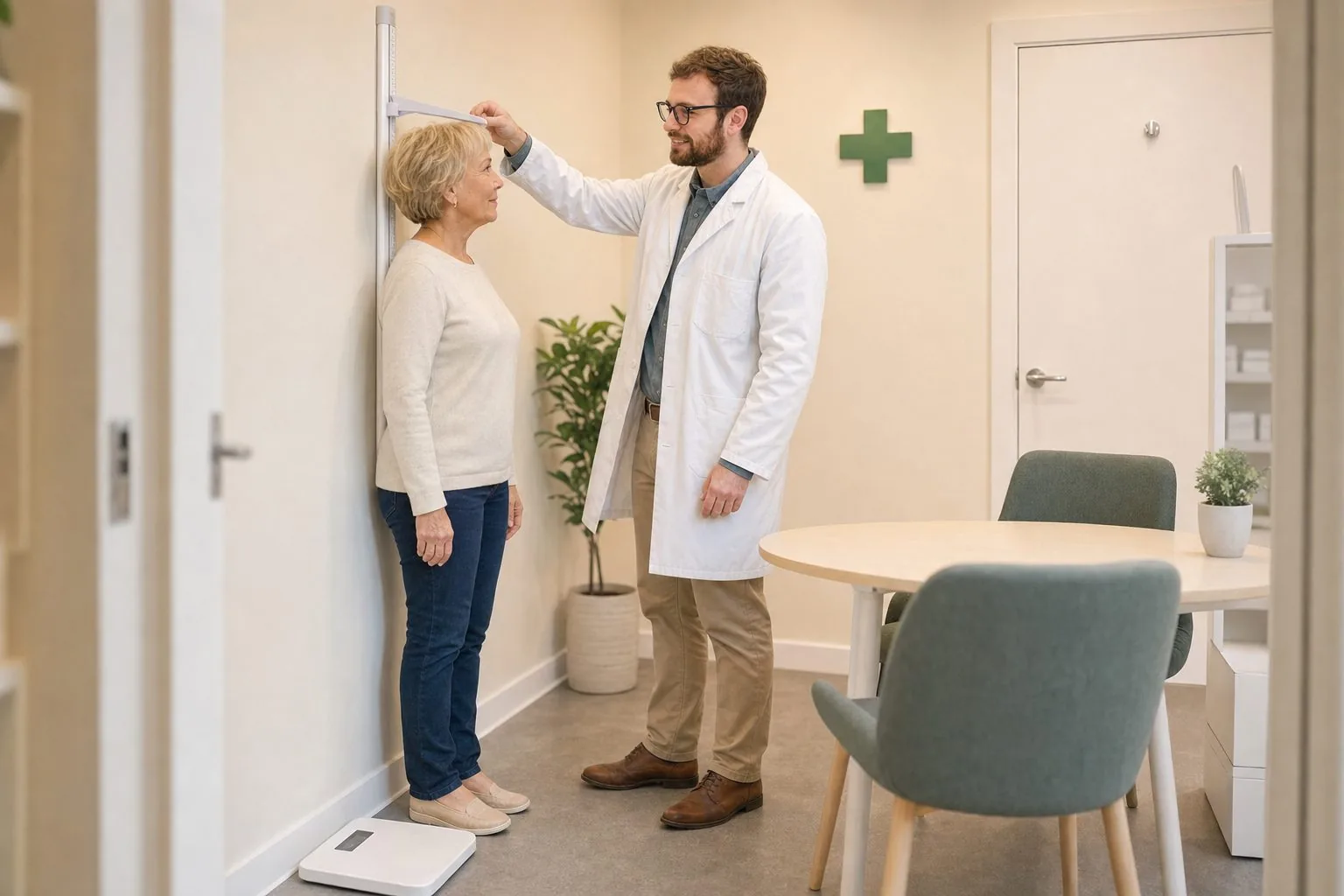
 Image is illustrative and does not show Hyde Park Pharmacy premises or staff.
Somewhere in the middle of almost every online weight-management form there are two empty boxes: height and weight. They look like the least important part of the process. In clinical terms they are close to the most important part, because everything downstream — whether treatment is appropriate at all, which options are on the table, what monitoring is needed — is built on top of those two numbers. At Hyde Park Pharmacy we do not take them on trust. We measure them, or we verify them independently, before a pharmacist makes any decision.
Patients sometimes read that as suspicion. It isn't. It is the same principle as a blood pressure reading before starting an antihypertensive, or a swab before an antibiotic: if a decision rests on a measurement, somebody has to actually take the measurement. This article explains what a verified BMI is, why the typed version fails, the four routes we accept, and what happens after the number reaches the pharmacist.
What a “verified BMI” actually means
Body mass index is simple arithmetic: your weight in kilograms divided by the square of your height in metres. The NHS BMI calculator does the same sum, and so does our own BMI calculator — a useful first look before a verified measurement. The resulting number is sorted into broad categories — underweight, healthy weight, overweight, and the obesity ranges above that.
A verified BMI is that same calculation with one difference: the two inputs came from a measurement someone can stand behind, rather than from a memory, an estimate, or a number typed into a box by the person who most wants a particular answer. Verification can mean we took the measurement ourselves; it can mean a clinician elsewhere took it recently and documented it; it can mean we watched it being taken. What it never means is that the figure arrived unaccompanied.
This matters more for weight-management medicines than for most other services because the treatment thresholds are defined in terms of BMI. NICE guideline NG246 on overweight and obesity management sets out how BMI is used alongside other factors when weight-management treatment is being considered, and typical criteria include a BMI at or above a defined level, or a somewhat lower level where a weight-related health condition is also present. If the BMI is wrong, the criteria have not really been applied — they have been simulated.
The short version: we are not checking whether you are telling the truth. We are checking that the number a clinical decision rests on is a real measurement. Those are different questions, and only the second one is ours to answer.
Why self-reported numbers fail — even honest ones
Three things go wrong with typed-in figures, and only one of them involves anybody being deliberately misleading.
Memory drifts. Most adults do not weigh themselves often. The number people report is frequently the last one they remember caring about — a holiday, a health check, a year ago. Height is worse: many people report the height they were measured at in their teens and never revisit it, and height genuinely does change across adult life. Because height is squared in the BMI formula, an error there moves the result more than the same-sized error in weight.
Home conditions vary. Bathroom scales on a thick carpet, scales that have never been reset, weighing fully clothed after a meal versus first thing in the morning — these produce a spread of readings for the same person on the same day. None of that is dishonesty; it is just an unstandardised measurement being treated as a precise one. If you use home scales, a firm flat floor and a consistent time of day are worth more than an expensive device; our range of digital weighing scales exists for exactly this kind of routine self-monitoring at home.
And there is an incentive problem. When a form is the gate between a person and a treatment they want, the form stops being a neutral question. It is not fair to patients to build a safety system that quietly rewards whoever rounds in the right direction, and it is not safe for us to pretend the incentive isn't there. The honest answer is to take the measurement out of the incentive's reach.
Regulators reached the same conclusion. The General Pharmaceutical Council's guidance for pharmacies providing services at a distance, including on the internet identifies categories of medicine that need additional safeguards, and is clear that prescribing decisions in these areas should not rest on an online questionnaire alone. Weight-management medicines sit squarely in that territory. Independent verification of height and weight is now an expectation of the service, not an optional extra a pharmacy can choose to skip to be more convenient.
How much difference does a few kilograms make?
More than people expect, because BMI categories have hard edges. The NHS sorts BMI into ranges with boundaries at 25 and 30, and treatment criteria are written against those boundaries. A person sitting a couple of units either side of a boundary is, on paper, in a different category — even though nothing about them has meaningfully changed.
Consider a straightforward arithmetic example. Someone 1.70 m tall who reports 82 kg has a BMI of about 28.4. The same person measured at 87 kg has a BMI of about 30.1. Five kilograms — well within the range of an honest guess, an old memory, or badly placed bathroom scales — moves the calculated figure across a category line. That is why the input has to be real before the output means anything.
BMI is a starting point, not a verdict
Insisting on an accurate BMI is not the same as claiming BMI tells you everything. It doesn't, and the guidance is explicit about its limits.
- It cannot tell muscle from fat. A very muscular person can have a high BMI without the health risks the number usually flags. This is a genuine limitation, not a loophole.
- Where weight sits on the body matters. NICE NG246 recommends using waist-to-height ratio alongside BMI for adults below a certain BMI level, as a practical way of accounting for central weight that BMI alone misses.
- Risk is not identical across populations. NICE advises using lower BMI thresholds when assessing people from some South Asian, Chinese, other Asian, Middle Eastern, Black African and African-Caribbean family backgrounds, because weight-related health risk can appear at a lower BMI.
- It is not designed for everyone. BMI is interpreted differently in pregnancy, in children and young people, and in some long-term conditions.
All of which strengthens the case for verification rather than weakening it. A pharmacist can allow for a limitation they can see. They cannot allow for a number that was never measured, because they have no idea which direction the error runs in.
What the verified number is used for
Weight-management medicines available in the UK include prescription-only options and pharmacy medicines, and they differ in how they work, who they may be suitable for, and what monitoring they need. The BNF treatment summary on obesity sets out the pharmacological options and the cautions attached to them; NHS guidance on obesity covers where medication sits alongside diet, activity and other support. Our weight-management service page explains how a consultation with our pharmacist works.
In a consultation, a verified BMI feeds into an assessment that also covers your medical history, current medicines, any weight-related conditions, previous attempts at weight loss, whether you are pregnant, breastfeeding or planning a pregnancy, your relationship with eating, and what support you would have alongside any treatment. Typical criteria for weight-management medicines include a BMI at or above a defined threshold, or a lower threshold where a weight-related condition is present — but meeting a threshold on paper is the beginning of the assessment, not the end of it.
How the decision is made: everything you tell us and everything we measure is passed to the pharmacist. The pharmacist reviews it, may contact you for more information, and decides whether treatment is clinically appropriate — and if not, what would be more useful instead. No form, calculator or algorithm on this website makes that decision, and none of them can approve or decline anything.
The risks of an unverified number
It is worth being direct about what goes wrong when the input is wrong, in both directions.
An overstated weight can lead to a person being assessed for a treatment their clinical picture does not actually support. Weight-management medicines have real side effects — gastrointestinal effects are common with several of them — and real contraindications. Taking on those risks for a benefit that was never indicated is a poor trade, and it is the kind of harm that only becomes visible later.
An understated weight is the quieter problem. Someone who plays down their weight out of embarrassment may be steered away from a conversation that would genuinely have helped them, or towards options that do not match where they actually are. Nobody ever complains about this, because the person never finds out what they missed.
Both directions distort follow-up. Ongoing weight-management care depends on tracking change over time. If the starting point was invented, the first genuine measurement produces a “change” that never happened, and everyone spends the next appointment explaining an artefact.
If you experience a side effect from any medicine, you can report it directly through the MHRA's Yellow Card scheme, and we would encourage you to tell us as well so it can go on your record.
The Hyde Park Pharmacy consultation process
Here is the sequence, plainly.
- You get in touch. WhatsApp, phone, or in person at 22-24 Woodsley Road. Tell us you are interested in a weight-management consultation.
- We arrange the measurement. Every weight-management consultation is either in person or by video. Either you come into the pharmacy and we take your height and weight ourselves, or we check them on camera during a live video consultation. A recent dated record from your GP or another NHS service can support that check, but it does not replace it.
- You complete the health questionnaire. Medical history, current medicines and supplements, allergies, previous weight-loss attempts, and anything else relevant. Your answers are passed to the pharmacist — the questionnaire itself decides nothing.
- A pharmacist reviews everything. Verified measurements, health history and questionnaire together. They may call you with follow-up questions; that is a normal part of the process rather than a sign of a problem.
- The pharmacist makes the clinical decision and explains it to you — including, where treatment is not appropriate, what the reasoning is and what the alternatives are.
- If treatment goes ahead, follow-up is part of it. Re-checks, monitoring, and a route back to us if something does not feel right. Weight-management treatment is a course of care, not a transaction.
If any step of this feels like an obstacle, it is worth saying that a service willing to skip them is not being kinder to you. It is being cheaper to run.
What to be wary of online
The demand for weight-management medicines has produced a large and aggressive grey market, and the tell-tale signs are consistent.
Treat these as red flags: a site that never asks for a verified height and weight; a “consultation” you can complete in under a minute with no clinician involved at any point; prescription medicines advertised, discounted or offered for sale directly to the public; sellers on social media or messaging apps; no GPhC premises registration number displayed and no named superintendent pharmacist; and anyone offering to supply without a prescription at all.
Medicines bought outside the regulated supply chain may be falsified — wrong drug, wrong strength, no active ingredient, or contaminated — and there is no recall, no traceability and no accountability behind them. The MHRA publishes advice on falsified medicines and how to report suspicious products, and you can check any registered UK pharmacy premises on the GPhC register — ours is premises number 9011727.
A pharmacy that asks you to stand on a set of scales before it will discuss treatment is showing you something useful about how it operates. So is one that doesn't.
Frequently asked questions
Do I have to come into the pharmacy in person?
Not necessarily. An in-pharmacy measurement is the most straightforward route, but the consultation can also be a live video call, with your height and weight checked on camera. A recent dated height and weight from your GP, hospital or an NHS clinic can support that check, but it does not replace the in-person or video consultation. Which route suits you is agreed when you get in touch.
Can I just send a photograph of my scales?
Photographs are useful supporting evidence and we are happy to receive them, but on their own they do not replace a measurement we take or witness — a photo cannot show us the surface the scales are on, when it was taken, or who is standing on them. Photos sit alongside one of the other routes rather than instead of one.
What if my BMI is close to a threshold?
Then the accuracy of the measurement matters more than ever, which is precisely why we verify it. Being near a threshold does not settle anything by itself: the pharmacist assesses your full clinical picture, including any weight-related conditions and the factors NICE recommends considering alongside BMI, and decides from there.
I'm very muscular and my BMI looks high. Does that count against me?
It is a well-recognised limitation of BMI that it cannot distinguish muscle from fat, and a pharmacist assessing you will take that into account — alongside measures such as waist-to-height ratio, which NICE recommends using with BMI in some situations. Tell us; a verified measurement plus context is far easier to assess than an unverified number.
Why do you need my height as well? I know how tall I am.
Height is squared in the BMI formula, so an error there shifts the result more than the same error in weight would. Many adults are also reporting a figure last measured years ago, and adult height genuinely changes over time. It takes about thirty seconds to check.
Does a verified BMI mean I'll be given treatment?
No. Verification makes the assessment meaningful; it does not determine the outcome. Your verified measurements and health information are passed to the pharmacist, who reviews everything and decides whether any treatment is clinically appropriate, and will explain the reasoning either way.
Is my information kept confidential?
Yes. Measurements, questionnaire answers and consultation notes are handled as confidential health records under UK data protection law and the professional standards we work to as a registered pharmacy.
Talk to us about a weight-management consultation
Book a measured height and weight check at Woodsley Road, or ask us which verification route would work best for you. A pharmacist reviews every consultation and makes the clinical decision.
Message us on WhatsApp Call 0113 244 1551Regulatory information
Hyde Park Pharmacy is a trading name of Pharmacareuk Ltd, 22-24 Woodsley Road, Leeds LS3 1DT. Telephone 0113 244 1551.
Registered pharmacy premises with the General Pharmaceutical Council, premises registration number 9011727 — verify our registration on the GPhC register.
Superintendent pharmacist: Shoyab Umarji, GPhC registration number 2065619.
Suspected side effects from any medicine can be reported to the MHRA through the Yellow Card scheme.
Sources
- National Institute for Health and Care Excellence — NG246: Overweight and obesity management.
- NHS — Calculate your body mass index (BMI).
- NHS — Obesity: overview, diagnosis and treatment.
- BNF (NICE) — Obesity treatment summary.
- General Pharmaceutical Council — Guidance for pharmacies providing pharmacy services at a distance, including on the internet.
- Medicines and Healthcare products Regulatory Agency — Advice on falsified medicines and buying medicines safely, and the Yellow Card scheme.
Where to get treatment
Our pharmacist can check what suits you. Every treatment is supplied only after a pharmacy consultation confirms it is appropriate.
Digital Weighing Scales →Weight Loss treatments →This is general information. Always consult a qualified healthcare professional before starting any new treatment.