
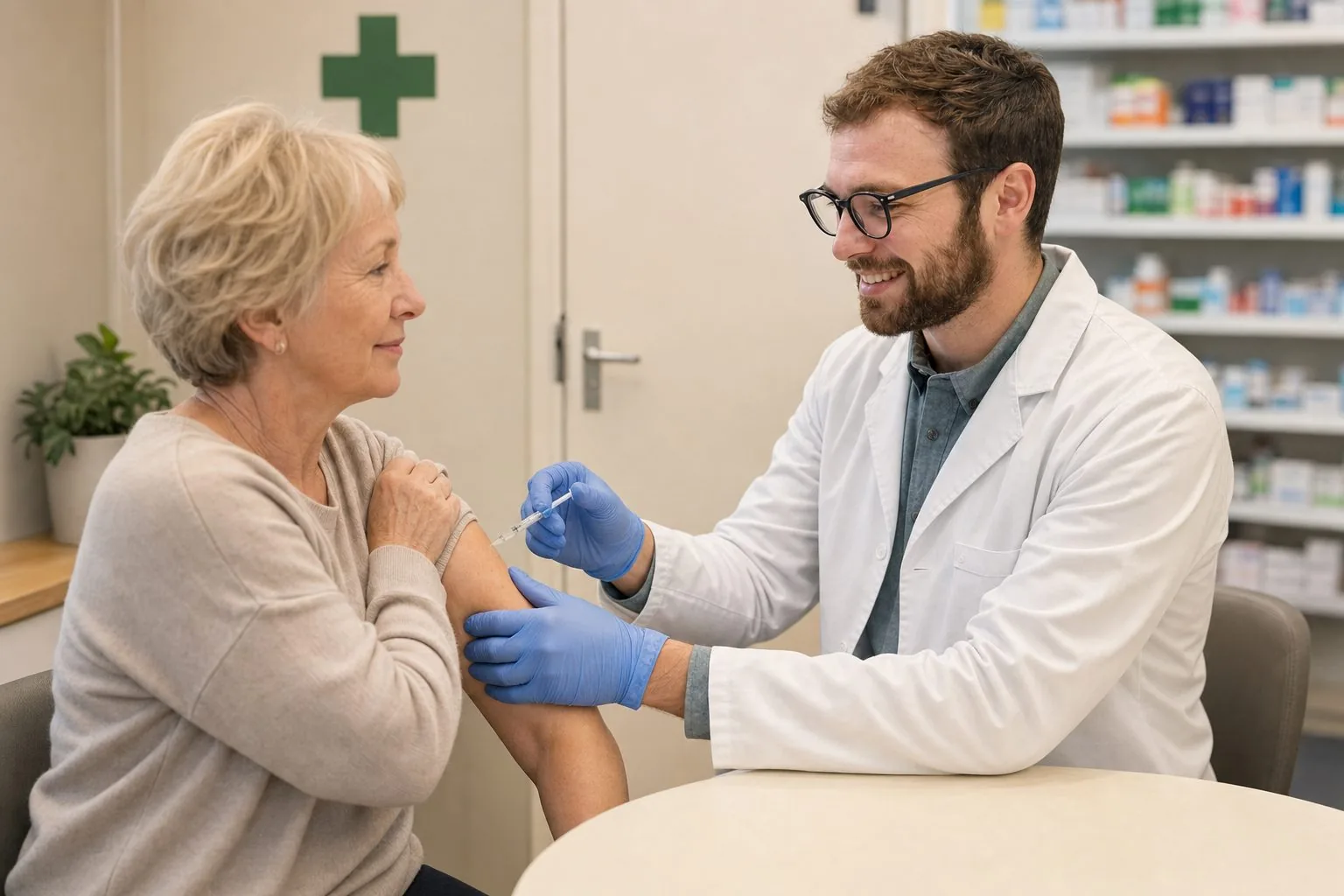
 Image is illustrative and does not show Hyde Park Pharmacy premises or staff.
Flu is not a bad cold. It is a separate viral illness that arrives quickly, flattens people for a week or more, and in some groups leads to pneumonia, hospital admission or a serious flare-up of an existing condition. The NHS runs a national vaccination programme every autumn and winter precisely because of that gap between inconvenience and genuine harm. This guide sets out plainly who the NHS invites, when in the season to get the jab, what a private flu vaccination is for, and what happens when you come to us in Hyde Park.
Ready to book? NHS and private flu jabs are both available at our Woodsley Road pharmacy for the 2026–27 season. Book your flu jab online, or walk in during opening hours.
What the flu jab actually does
Influenza viruses change from year to year. That is why the vaccine is reformulated annually and why one jab does not protect you for life — last winter's vaccine is not matched to this winter's circulating strains. The composition of each season's vaccines is reviewed internationally and set out in the UK annual flu programme guidance published on GOV.UK.
The vaccine works by showing your immune system the surface proteins of the expected strains so that it can respond faster if you meet the real virus. The NHS explains that protection is not immediate — it takes around two weeks to build after the injection (NHS: flu vaccine). That two-week lag is the single most practical fact in this article, and it is the reason timing matters as much as the jab itself.
It is also worth being honest about what the vaccine does not do. It does not guarantee you will avoid flu, and it does nothing against the many other winter viruses that cause colds, sore throats and coughs. What the evidence supports is a meaningful reduction in your chance of catching flu and, importantly, in the chance of a severe outcome if you do. NICE guideline NG103 is built around increasing uptake in exactly those groups where severe outcomes are most likely.
The flu jab cannot give you flu. The injected vaccines used for adults in the UK do not contain live influenza virus. The children's nasal spray does contain a weakened live virus, but it is attenuated so that it cannot cause flu illness. Feeling a bit rough for a day afterwards is your immune system responding — not an infection.
Who the NHS offers a free flu vaccination to
Each season the NHS publishes the list of groups it offers free flu vaccination to. For the 2026 to 2027 season the national flu immunisation programme letter (GOV.UK, as amended on 9 June 2026) lists these groups:
- From 1 September 2026: pregnant women; all children aged 2 or 3 years on 31 August 2026; primary and secondary school-aged children (reception to year 11); and children in clinical risk groups aged from 6 months to under 18.
- From 1 October 2026: people aged 65 and over; people aged 18 to under 65 in clinical risk groups; people living in long-stay residential care homes; carers who receive carer's allowance or are the main carer of an elderly or disabled person; close contacts of people with a weakened immune system; frontline health care workers; and frontline social care workers without an employer-led occupational health scheme.
- Added for 2026 to 2027: people aged 16 and over who are experiencing homelessness, from 1 October 2026 (GOV.UK amendment).
The list is broadly stable from year to year, but the details — particularly the age bands for children and the qualifying health conditions — are reviewed annually, so check the current season's list rather than relying on what was true last winter. Our flu jab page sets out who we can vaccinate on the NHS this season.
If you recognise yourself or a family member in one of those categories, that is a prompt to have the conversation — not a decision. Whether NHS vaccination goes ahead on the day is a clinical judgement made by the pharmacist after reviewing your answers against the current national criteria and your medical history.
When to book — and why timing matters
Because protection takes around two weeks to develop, the useful question is not “is flu about yet?” but “will I be covered by the time it is?” For the 2026 to 2027 season, NHS vaccination starts on 1 September 2026 for pregnant women and children, and on 1 October 2026 for people aged 65 and over and the other adult groups (GOV.UK). Opening dates are set nationally and shift from year to year, so check the current schedule on the NHS flu vaccine page or book your flu jab with us.
NHS vs private flu jab: what is the difference?
This is the part that causes most confusion, so here it is plainly. The vaccine itself is not a lesser product when you pay for it — private services in the UK use licensed influenza vaccines held to the same regulatory standard by the MHRA. The real difference is who funds it and who it is for.
NHS flu vaccination is free and targeted at the groups where flu causes the most harm. A private flu jab exists for everyone else: the healthy 40-year-old who cannot afford a week off work, the student heading into halls, the person who falls just outside this season's published criteria, or someone who simply wants to reduce their chance of a miserable January.
| NHS flu vaccination | Private flu vaccination | |
|---|---|---|
| Cost to you | Free | £15 this season — see our flu jab page |
| Who it is intended for | The groups published in the national programme each season | Adults outside those groups who want to be vaccinated |
| Vaccine | A licensed vaccine appropriate to your age group | A licensed vaccine appropriate to your age group |
| Assessment | Pharmacist checks the national criteria and your history | Pharmacist checks suitability and your history |
| GP record | Notified to your GP as part of the NHS service | We can provide a record for your GP with your consent |
| When available | While the national programme is running | While we hold stock for the season |
One practical note: if you are in an NHS group, do not pay. Come and talk to us first. It is common for people to assume they have missed a deadline or fallen off a list when in fact the NHS service is still open to them.
Which vaccine will I be given?
There is no single “flu vaccine” — several licensed products are used in the UK, and which one is appropriate depends mainly on age. Older adults are generally offered vaccines designed to produce a stronger response in an ageing immune system; younger adults are offered a standard injected vaccine; children are usually offered a live attenuated nasal spray rather than a needle. The clinical detail behind those choices sits in Chapter 19 of the Green Book, and the product-level information is in the BNF influenza vaccine monograph.
You do not need to choose. Tell us your age, your health conditions and any allergies, and the pharmacist selects the appropriate product from what we hold.
Flu and COVID-19 vaccination together
Where both are due, they can often be given at the same appointment, typically in different arms. Whether that applies to you on the day depends on the current national guidance and your individual circumstances, and it is something the pharmacist will confirm with you rather than something to assume in advance.
Side effects and what to watch for
Most people have either no side effects or mild ones that settle within a day or two. The NHS lists the common ones as a sore or slightly swollen arm at the injection site, a mild temperature, aching muscles and tiredness. The nasal spray given to children more often causes a runny or blocked nose, headache or tiredness.
Seek urgent medical help if you develop signs of a serious allergic reaction — swelling of the face, lips, mouth or throat, difficulty breathing, a widespread rash, or feeling faint. Serious reactions to flu vaccines are rare, and the pharmacy team is trained and equipped to manage one if it happens on the premises. Call 999 if symptoms are severe.
Tell the pharmacist before your jab if you have ever had a serious allergic reaction to a vaccine or to eggs, if you are taking an anticoagulant or have a bleeding disorder, if you have a weakened immune system, or if you are unwell with a fever on the day. None of these automatically rules out vaccination — several simply change which product is used or whether it is better to come back another day. The pharmacist reviews the detail and makes that decision with you.
Any suspected side effect from a vaccine can and should be reported through the MHRA Yellow Card scheme. Reports come from patients and carers as well as healthcare professionals, and they are how safety signals get spotted across the whole population. We are happy to help you submit one.
Buying vaccines online — what to be wary of
Influenza vaccines are prescription-only medicines. In the UK they are administered by trained professionals working under a patient group direction or a prescription, in registered premises with the equipment to manage a reaction. That is not bureaucracy — it is the reason the service is safe.
So treat any website offering to post you a flu vaccine, or offering vaccination without a health check, as a warning sign. Products bought that way are outside the regulated supply chain: there is no assurance of what is in the vial, and vaccines are temperature-sensitive, so even a genuine product that has been shipped badly may not work. Before using any online pharmacy, check it appears on the GPhC registers, and report suspicious medicines or sellers to the MHRA.
How the flu jab works at Hyde Park Pharmacy
We are on Woodsley Road, a few minutes from Hyde Park and the university campuses, and the process is deliberately short.
- Book or get in touch. Book your flu jab online, call 0113 244 1551, message us on WhatsApp, or come in. Tell us your age and any health conditions so we can tell you what is likely to be available to you.
- Complete a short health questionnaire. It covers your age, medical history, medicines, allergies and pregnancy status. Your responses are passed to the pharmacist — the form does not make any decision about your care.
- The pharmacist reviews and decides. They check your answers against the current NHS criteria and the product information, discuss anything that needs clarifying, and decide whether vaccination is appropriate for you today and which vaccine to use. If it is better to wait — because you are unwell, for example — they will explain why and when to come back.
- The vaccination. An injection into the upper arm, over in seconds. Wear something with a sleeve you can push up easily.
- A short wait, then you are done. We ask you to stay briefly so we can check you feel well before you leave, and with your consent we make sure the vaccination is recorded for your GP.
No decision about your vaccination is made by a form or an algorithm. Everything you tell us is passed to the pharmacist, who holds the final clinical decision and will talk it through with you.
If you catch flu anyway
Vaccination reduces risk; it does not abolish it. If flu does get you, the NHS advice is rest, plenty of fluids, and treating the fever and aches while your body clears the virus. Simple paracetamol is the usual first choice for fever and aching — check the label for the maximum daily dose and remember that many cold and flu combination sachets already contain paracetamol, so it is easy to double up by accident. A digital thermometer is useful for tracking a temperature, particularly in children or older relatives. You can see the rest of what we keep for winter illness on our cold and flu page.
Contact your GP, call 111, or speak to us if you are in a higher-risk group, if you are breathless, if symptoms get worse rather than gradually better after the first few days, or if a high temperature does not settle. Antiviral treatment exists but is only appropriate in specific circumstances and needs a prescriber's assessment.
Frequently asked questions
Can the flu jab give me flu?
No. The injected vaccines used for adults in the UK do not contain live influenza virus, so they cannot cause flu. The children's nasal spray contains a weakened live virus that is not capable of causing flu illness. Feeling achy or slightly feverish for a day is a normal immune response, not an infection.
I had a flu jab last year. Do I need another one?
Yes. Influenza viruses change, the vaccine is updated each season to match the expected strains, and the protection from one season's vaccine declines over time. A flu jab is an annual thing, not a one-off.
Is it too late to have one in December or January?
No. Flu typically circulates through the winter months, so vaccination later in the season can still be worthwhile while the programme is running — it simply means you spend part of the winter unprotected while immunity builds. Earlier is more useful, but late is better than never.
I'm pregnant. Is the flu jab safe?
Flu vaccination is offered to pregnant women at any stage of pregnancy as part of the NHS programme, because flu can be more serious during pregnancy. The inactivated injected vaccine is used. Tell the pharmacist you are pregnant and they will discuss it with you and choose the appropriate product.
Can I get the jab if I'm allergic to eggs?
Often, yes — egg allergy does not automatically rule out flu vaccination, and there are options for people who cannot have egg-grown vaccines. What matters is the severity of your reaction and your history. Tell the pharmacist before your appointment; they will assess it and decide whether to vaccinate here or to refer you.
How much is a private flu jab?
A private flu jab at our pharmacy is £15 for the 2026–27 season. If you are in one of the NHS groups above, your jab is free on the NHS instead — check before you pay. You can book your flu jab online or call us on 0113 244 1551.
Can I bring my child for a flu jab?
For the 2026 to 2027 season, children aged 2 and 3 can be vaccinated at their GP practice from 1 September and, from 1 October 2026, at community pharmacies that offer it; school-aged children are vaccinated through the schools programme (GOV.UK). Children are normally offered the nasal spray rather than an injection. Our flu jab page shows what we offer for children, or ring us and we will tell you which route applies to your child this season.
Book your flu jab in Leeds
We are at 22-24 Woodsley Road, LS3 1DT. Book online, or message or call and we will tell you what is available to you this season — NHS or private — before you come in.
Book your flu jab WhatsApp us Call 0113 244 1551Regulatory information
Hyde Park Pharmacy is a trading name of Pharmacareuk Ltd, 22-24 Woodsley Road, Leeds LS3 1DT. The pharmacy is registered with the General Pharmaceutical Council under premises registration number 9011727 — you can verify this entry on the GPhC register.
Superintendent pharmacist: Shoyab Umarji, GPhC registration number 2065619.
Influenza vaccines are prescription-only medicines and are supplied and administered under a patient group direction or prescription following a clinical assessment by the pharmacist. Suspected side effects from any vaccine or medicine should be reported through the MHRA Yellow Card scheme at yellowcard.mhra.gov.uk.
Sources
Where to get treatment
Our pharmacist can check what suits you. Every treatment is supplied only after a pharmacy consultation confirms it is appropriate.
Paracetamol 500mg Tablets →Digital Thermometer →NHS & Pharmacy First treatments →Cold & Flu treatments →This is general information. Always consult a qualified healthcare professional before starting any new treatment.